
Devotionals
Improve Your Mental Health and Boost Your Resilience
{"title":"Improve Your Mental Health and Boost Your Resilience","excerpt":"Good mental health is important for us to have. However, we also need to care for it so it stays healthy. Our mental health is influenced by many things...","slug":"improve-your-mental-health-and-boost-your-resilience","segments":[{"i":100,"t":"According to research, resilience is a pattern, so it can be trained. It is a mindset. Resilience concerns what we think, what we feel, and our behavior. This can begin to be trained, even from early childhood."},{"i":101,"t":"4 Important Elements of Resilience"},{"i":102,"t":"Attention: how much attention do resilient people give to positive and negative events in life?"},{"i":103,"t":"Action: how do resilient people face positive and negative events in their lives?"},{"i":104,"t":"Thoughts: how do resilient people think about positive and negative events in their lives?"},{"i":105,"t":"Motivation: what motivates resilient people when facing positive and negative events in their lives?"},{"i":106,"t":"How Can Resilience Be Built in a Family?"},{"i":107,"t":"First of all, building resilience requires awareness. From there, we can then have choices and make decisions. Training resilience requires patience because it is a continuous process and can keep developing. One way to train resilience is through small victories. If our child succeeds in writing or speaking, we can say, \"Yay!\" and clap our hands. If they fall down, that is okay; we also need to embrace that."},{"i":108,"t":"It is not only our physical muscles that need training, but our mental muscles as well. Our spiritual, physical, social, and mental muscles need to be trained continually. One way to train our minds is by reading God’s Word and recognizing:"},{"i":109,"t":"What are our resources? (What do we have?)"},{"i":110,"t":"What are our strengths?"},{"i":111,"t":"What are our abilities?"},{"i":112,"t":"Tips"},{"i":113,"t":"Like mental health, resilience also has a scale. When we can improve mental health, we can also strengthen our mental resilience. There are 2 factors that affect this mental resilience scale, namely protective and risk factors. Protective factors are good things, while risk factors are bad things. Examples of protective factors are a warm family and a stable environment. Risk factors are the opposite. If we want to increase resilience, we also need to increase protective factors."},{"i":114,"t":"We also need to build good relationships, for example through good communication. For example: praise a child when they do what is right, and give a good response to people who speak to us."},{"i":115,"t":"May this event help us understand more deeply the importance of mental health, and make us willing to keep striving to train ourselves to have stronger mental resilience. We can also help and treat the people around us who are experiencing mental problems in a better way, accepting, loving, and valuing them. Having eyes and a heart like Jesus. We can also begin to practice in our daily lives every tip that has been shared. Keep going!!"}]}
The event, titled “Improve Your Mental Health And Boost Your Resilience,” was presented by Mrs. Alice Arianto. She is a doctor in the field of clinical psychology, and in her daily work she helps many teenagers, adults, and families in the area of mental health. Even though the event was held online, it did not lessen the enthusiasm of the participants who attended.
Mental Health
Alice opened this event by explaining what aspects human beings have that cannot be separated. And what the definition of mental health actually is. Quoting the Bible verse Luke 2:52, human beings consist of 4 aspects, namely:- Mental
- Physical / body
- Spiritual
- Relationships / Social
She reminded us that we need to have the ability to cope with stress because as long as we live we will never be free from stress. Stress can come at any time and to anyone, such as when we are hurt, left alone, or when someone we love dies. Challenges, problems, and failures will certainly exist. But when our mental health is good, we can deal with them without having to fall into depression.
Facts show that 1 in 4 adults has experienced mental health problems in life each year, whether severe or mild. And 1 in 17 people has experienced serious mental health problems. Mental health problems can happen to anyone, regardless of age or profession.
What are people with healthy mental health like?
People Who Are Mentally Healthy
“The thief comes only to steal and kill and destroy; I came that they may have life, and have it abundantly” (John 10:10)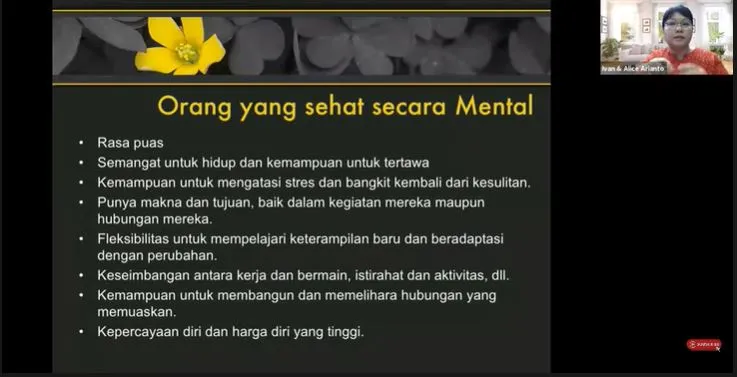 People who are mentally healthy will have a sense of (content & satisfied), joy, and enthusiasm for life. They have the ability to rise again, and they also have purpose in everything, whether in relationships (relationship) or in activities or work. For example, parents who have good mental health have purpose, knowing what they want to do today and tomorrow. Meanwhile, those whose mental health is poor usually have no purpose, so their thoughts can turn negative, for example constantly wanting to commit suicide.
People with good mental health will adapt easily and be willing to learn new things. They are like bamboo that, when kicked, can bounce back and stand up again. They are flexible, able to overcome problems, have a balanced life between play and activity, and can also build and maintain relationships. People who are mentally healthy have good self-worth and self-confidence.
The church is the safest place for everyone
Alice reminded us of the role of the church or the congregation. The church is the safest place for everyone. People who experience depression or loneliness can find true love within the congregation. We as a congregation also need to understand how to help others who are struggling in this area, so that they may have good spirituality and mental health. As a result, more people will eventually experience the love of Jesus in their personal lives.Let us also look at and learn from the heart of Jesus: what did Jesus do for people who had mental health problems?
Jesus healed them
“So the news about Him spread throughout all Syria, and they brought to Him all who were suffering, afflicted with various diseases and pains, those who were demon-possessed, epileptics, and paralytics, and Jesus healed them.” (Mat 4:24)Jesus healed those who came with all kinds of conditions and problems. As believers, should we not also have the same heart as Jesus?
We can admit that mental health problems are something frightening. We do not know what to do or how to treat them. As a result, those who have mental health problems tend to be isolated and hidden away. Usually families feel ashamed if there is a family member or someone close to us who experiences this problem. In Indonesia itself there are many cases of people being put in restraints.
No one expects to experience mental health problems. No one wants to go through depression, OCD, and other mental health issues. But this is real, and it is around us. Let us reflect for a moment! What happens when we feel abandoned and excluded? How do we feel?
But when someone accepts and values us, it helps us begin to feel that we are valuable. Even more so when we know there is someone struggling to accept us despite the many burdens and whatever else we are facing. In the Bible there are many examples of people who experienced mental health problems, and from the Bible we can also learn how to treat them.
There is the story of Zacchaeus, a tax collector, who was not accepted by others, but the Lord was sensitive to what he needed in order to feel valued. Jeremiah also experienced stress. Ezekiel was also depressed when he saw the dry bones. Then there was Job, a good man who loved God deeply yet went through terrible suffering. There were also the people walking to Emmaus, who were so anxious. And there was also the prodigal son, who in the depths of his depression even ate pig food.
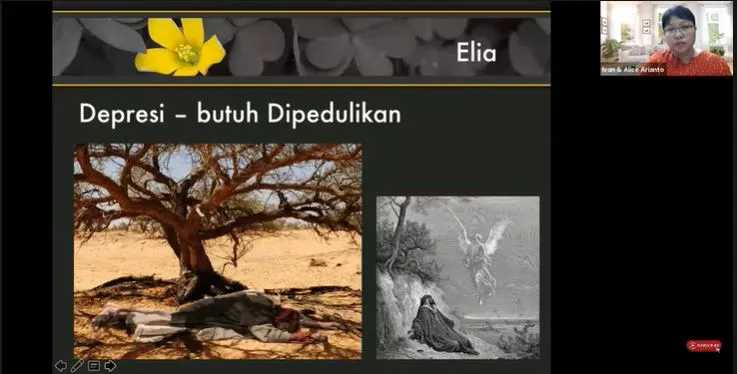 Elijah once experienced severe depression after he faced the 450 prophets of Baal alone and heard the news that Jezebel would kill him. Elijah felt tired and alone. But God did not leave or abandon him; God cared for Elijah, telling him to eat and rest. And after Elijah recovered, God again entrusted him with an important task.
Experiencing depression is not the end of everything. When someone is mentally ill, it does not necessarily mean that God no longer uses them. When they can overcome it and recover, God will use that person again for His glory. We meet many people with these mental health problems. A simple thing we can do is show care, acceptance, appreciation, listen to them, and love them. When people can feel our care and love, it can help them find their life again.
Alice describes depression like falling into a very deep and dark hole. Even though people really want to help us and reach out, their help may not reach us because of how deep, bleak, and dark our fall is. When someone throws a rope to us, sometimes we do not even have the energy to reach it and climb up. Only God's love can help. Patiently He reaches out His hand and waits until we are ready and able to take hold of it. When He lifts us up, we are healed and restored.
What kind of inner eyes do we need to have?

- The inner eyes of someone experiencing depression. What do those eyes look like? Perhaps emptiness, perhaps no hope until we see Jesus. Until God sends people around us to help.
- The inner eyes of someone looking at a person with depression. It is like when we see Zacchaeus, the weeping woman, a sinner. We feel afraid of what that depressed person might do to us, for example being afraid of being hit or killed. Or we may also judge because we feel better than they are
- Inner eyes like Jesus'. That is, the Lord wants that person to be healed and restored. God heals. And God can heal others through us.
The Human Brain
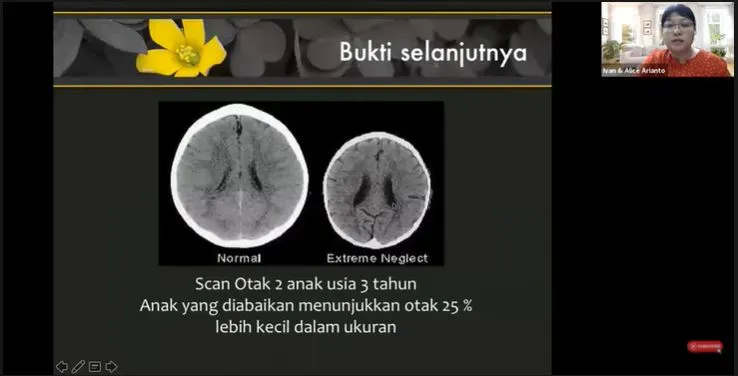
Alice also shared facts about the human brain. Through neuroscience, we can understand the condition of the human brain. God is amazing. No matter what tribe we are born into, our brains are the same, weighing 1.36 grams. And amazingly, the human brain is plastic, meaning it can be repaired and recover.Alice gave a comparison between a normal brain and a brain experiencing mental health problems, such as traumatic brain injury (TBI), OCD, and seizure activity (such as epilepsy). The brains of children in orphanages are also different from those of children loved in a family. Those who are oftenneglected or emotionally neglected, rarely spoken to, can have brains that shrink by as much as 25%. Yet amazingly, this can heal.
Our brain has a vast number of networks, like the Amazon forest. In the adult brain there are around 200 billion neurons. Babies have 100 million connections. And this is the key: when we want to be mentally healthy, it all begins with our thoughts. Can people who have experienced trauma recover? When someone has gone through trauma, is often scolded and excluded, and then meets people who can accept them, a new pathway will be formed. The brain is plastic; it can change through therapy or through experiences in the congregation, in a group, being accepted, loved, and valued.
 Mental health is all in our minds. But our emotions also need to be healthy. Therefore, a relationship needs to be built. A healthy family must have relaxed relationships. Do not only ask, “Have you studied, are you up, have you showered, have you brushed your teeth, are you online yet?” A child will feel tense. We need to be able to play with them, study, eat, watch, sing, dance, and play together with them.
Tips for healthy mental health are very simple. It has to begin with self-awareness first. If we are not aware, we will not do anything.
Proverbs 14:30 A tranquil heart refreshes the body, but envy rots the bones.
We need to have a tranquil heart, one that is calm and relaxed.
Principles of Mental Health
Mental health is like a scale filled with good things and bad things. We need to make a list of what is good and what is bad for our mental health. The bad things include worrying about finances, an unstable environment, etc. We also need to write down the things that are good for our mental health, such as a caring spiritual community, and so on. Which side of our scale tends to have more weight? The good things or the bad things?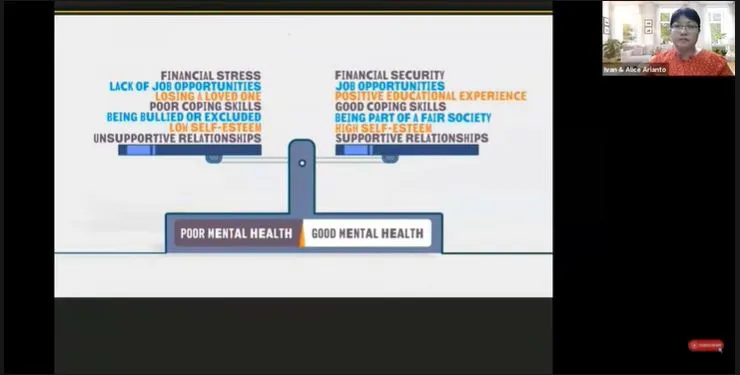 By writing them down, we become more aware of where we are. When we have awareness, we have choices about what we want to take on. But if we are never aware, then we have no choices and cannot make any decisions. Those decisions will help us make changes.
Alice also reminds us to be grateful, because the people around us are not perfect. Because if they were all perfect, we would be stressed. It is precisely because we are not perfect that we need God. We become perfect because God is the One who perfects us.
7 Keys to Mental Health
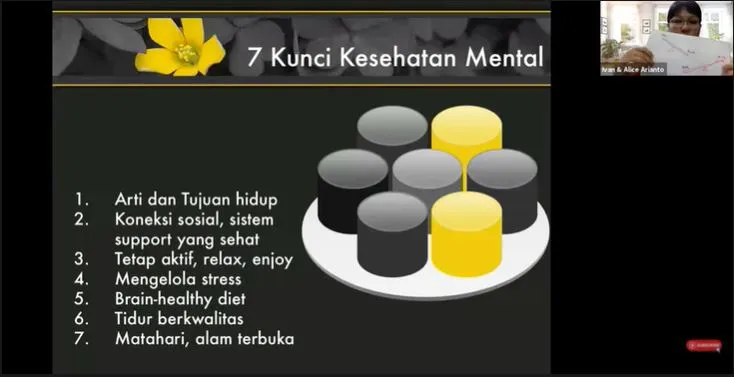 . Having meaning and purpose in life
Our mental health will be stronger when we have a clear purpose in life. Becoming a disciple gives us a clear purpose: to seek God, draw near to God, and live with vision & mission. There are also many people who have everything, yet have no purpose. They get this procedure and that procedure to look more attractive, yet they are still stressed. People without purpose will surely be stressed.
“And we know now that God works in all things to bring about good for those who love Him, who have been called according to God’s purpose.” - Romans 8:28
We need to believe that whatever happens in our lives, God has a good purpose and plan. Even in the midst of covid like this, we also hear a lot of good news, such as healing, people coming to know God, more harmonious family relationships, and more.
Purpose somehow gives your brain resilience. It makes your brain stronger and resistant (Boyle et.al, 2021)
We need to have the mindset that problems and failures will always come (come & go) (Ecclesiastes 9:11, Job 5: 7) But we need to focus on Jesus and keep moving forward so that we can be healthy. If we stay still and stagnant, we will surely become stressed, depressed, and have mental problems.
“Let us do it with our eyes fixed on Jesus, who leads us in faith and brings our faith to perfection, who for the joy set before Him endured the cross, despising its shame, and now is seated at the right hand of the throne of God.” - Hebrews 12:2
To have sound mental health, we must always have a purpose.
2. Social Connection, a Healthy Support System
We need to stay connected with one another in order to remain emotionally healthy.
3. Stay active, relax, and enjoy
People who experience mental illness usually remain inactive, shut themselves up at home, and do nothing. Parents are advised to keep doing activities they enjoy, for example cooking and gardening
4. Managing Stress
5. Brain-Healthy Diet
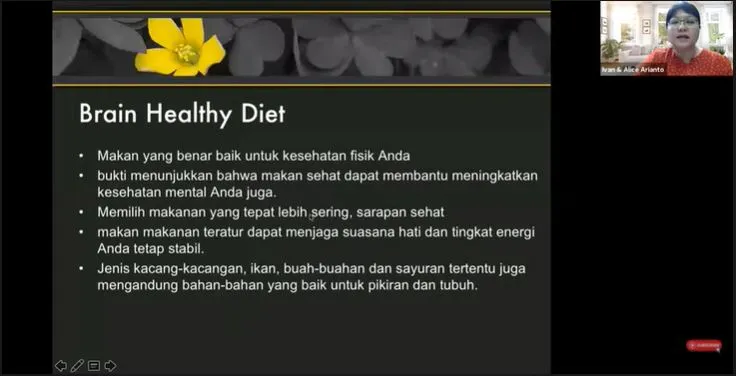 We need to eat healthy food, properly, and regularly. The atmosphere during meals should also be pleasant; do not eat fatty foods.
6. Quality sleep
7. Sunlight, the outdoors
Those seven things are actually not difficult and can be done.
Have a healthy mind - Healthy & Godly Thinking (Phil 4: 4-8)
Healthy thinking is thinking about something in a balanced way (seeing a situation or problem for what it really is). This means we look at all the factors in a situation and then decide how we feel about it. Practicing healthier and more balanced thinking can help us respond to life events and relationships. It can also increase our confidence and self-worth.Membuat jadwal rutin (Create Daily Routine)
(gambar5&6)Ketika orang mempunyai rutinitas, orang akan merasa aman. Kita perlu tahu jadwal kita, misalnya makan jam berapa, mandi jam berapa. Rutin membentuk suatu kebiasaan, dan kebiasaan itu membuat mental health seseorang menjadi sehat. Orang yang pola hidupnya jelas, biasanya memiliki mental health yang sehat. Contoh: orang gila, tidak ada jadwal kapan makan, mandi, tidur, sehingga kesehatan mentalnya terganggu. Anak-anak yang jadwalnya tidak diatur pasti akan mengalami masalah mental. Oleh karena itu, penting untuk memiliki rutinitas dari Senin - Minggu, dari pagi sampai sore. Rutin itu sangat membantu untuk sehat.
The Healthy Mind Platter
Ada 7 hal yang penting untuk kesehatan mental dan otak yang sehat. Kita perlu membagi waktu kita ke dalam 7 hal ini agar kita memiliki mental health yang sehat: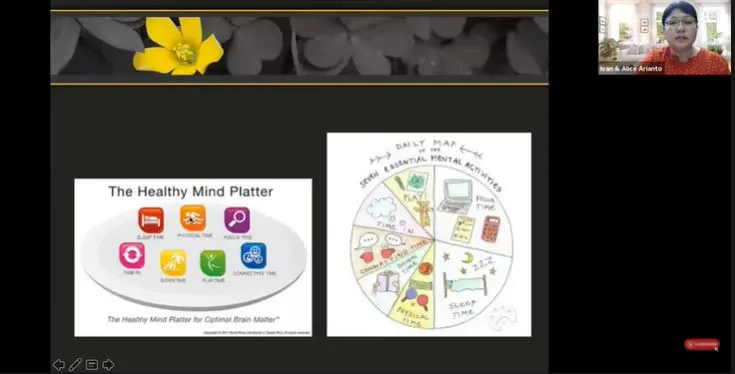
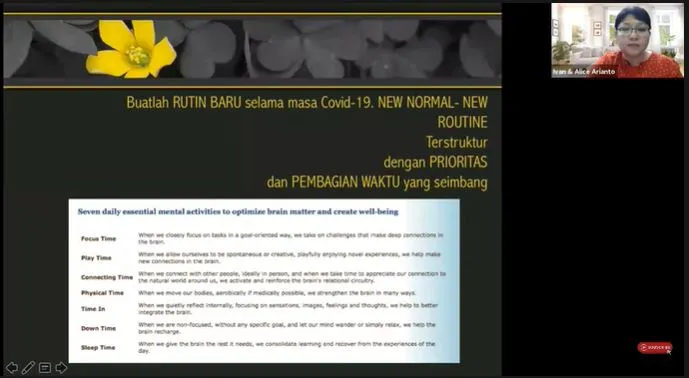 1. Sleep Time (Tidur)
2. Physical Time (Olahraga)
3. Focus Time (Belajar atau Bekerja)
Buat anak-anak, focus time adalah waktu untuk belajar. Untuk orang dewasa adalah bekerja.
4. Time In
Contoh time in adalah: me-time, waktu tenang, waktu dimana kita bisa relax.
5. Down Time
6. Play Time (Waktu bermain)
7. Connecting Time (Waktu untuk Bersosialiasi)
Pause & Savor
Kita perlu memiliki waktu untuk pause. Pause artinya diam sejenak, bukan berhenti. Pause, just to be here & now.Savor adalah momen dimana kita bisa menikmati sesuatu. Misalnya saat kita makan es krim, kita bisa merasakan dinginnya es krim, bisa merasakan aliran air ketika mandi, mencium wangi sabun, merasakan enaknya minum teh. Di kitab Yehezkiel dikatakan bahwa ia mengecap Firman Tuhan itu manis seperti madu. Bisa merasakan kebaikan Tuhan dan mengalami satu kedamaian. Bisa merasakan semilir angin. Ini adalah ciri dari orang yg mental health-nya sehat.
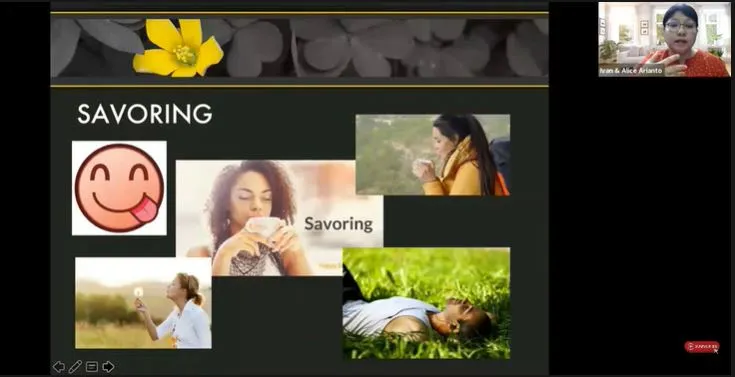 Terkadang kita mengerjakan sesuatu dengan terburu-buru. Savor itu penting. Jangan kerja terus, sampai kita lupa menikmati hidup.
Resilience (Ketahanan mental)
Saat kita memiliki mental health, kita memiliki resilience. Resilience adalah ketangguhan. Resilience bukanlah sesuatu yang statik, tetapi terus menerus. Hal ini yang dialami oleh Paulus. Ia mengalami pembantaian, disiksa, masuk penjara, dll, tetapi dia tetap bertahan.Resilience is the process of adapting well in the face of adversity, trauma, tragedy, threats or significant sources of stress, such as family and relationship problems, serious health problems or workplace and financial stressors. It means “bouncing back” from difficult experiences.
Resilience adalah kemampuan kita beradaptasi terhadap kesulitan, tragedi, trauma, apapun dalam hidup. Dan kita tetap bisa bertahan dan tangguh. Resilience juga adalah tema utama dalam Alkitab, dan itu yang dilakukan oleh Yesus. Ibrani 12:1-3 menunjuk kepada teladan Yesus dalam hal ketahanan mentalnya. Yesus menanggung cemooh dan penderitaan salib dan oposisi dari orang berdosa, tapi Yesus terus memenuhi panggilannya. Di dalam segala kesulitannya, Yesus terus bertahan menghadapi semua itu. kita juga dapat belajar dari banyak tokoh Alkitab lainnya seperti Yusuf, Ester, Daniel, dan Paulus.
“The difference between average people and achieving people is their perception and response to failure. If you are not failing, you are probably not really moving forward.” Maxwell
Menurut Maxwell, yang menjadi perbedaan antara orang yang berhasil dan yang gagal adalah bagaimana persepsi dan respon mereka terhadap kegagalan. Kalau kita tidak pernah gagal, kita tidak pernah maju. Jadi, it’s ok untuk gagal dan lakukan kesalahan, yang penting kita terus bertahan.
“Resilience is very much a learnt pattern of feeling, thoughts, and behaviours”
Menurut research, resilience itu adalah pola. jadi bisa dilatih. Itu adakah pola pikir. Resilience menyangkut tentang apa yang kita pikir, kira rasa, dan perilaku. Hal ini bisa mulai dilatih, bahkan dari anak-anak kecil.
4 Elemen Penting dalam Resilience
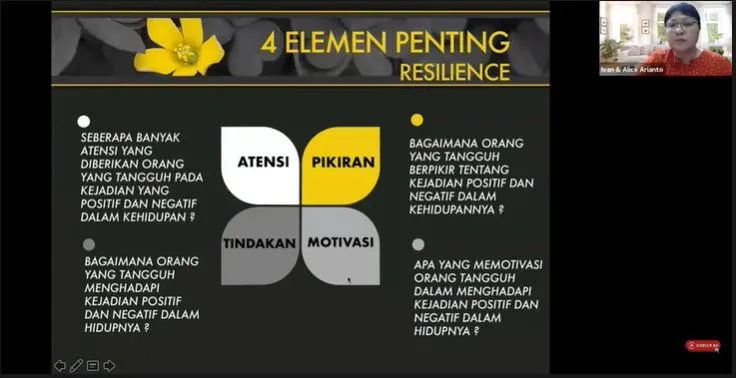
- Atensi: seberapa banyak perhatian yang diberikan orang yang tangguh pada kejadian yang positif dan negatif dalam kehidupan?
- Tindakan: bagaimana orang yang tangguh menghadapi kejadian positif dan negatif dalam hidupnya?
- Pikiran: bagaimana orang yang tangguh berpikir tentang kejadian positif dan negatif dalam hidupnya?
- Motivasi: apa yang memotivasi orang yang tangguh dalam menghadapi kejadian positif dan negatif dalam hidupnya?
Bagaimana Membentuk Resilience dalam sebuah Keluarga?
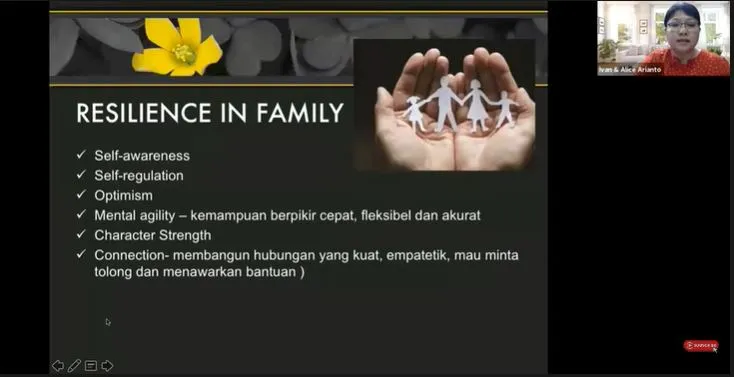 Pertama-tama, untuk membentuk sebuah resilience diperlukan kesadaran. Dari situ, baru kita bisa punya pilihan, dan bisa ambil keputusan. Melatih resilience itu diperlukan kesabaran karena merupakan proses yang terus menerus, dan dapat terus dikembangkan. Salah satu cara melatih resilience adalah dengan melalui kemenangan-kemenangan kecil. Kalau anak kita berhasil menulis, atau ngomong, kita bisa berkata, “Yayy” dan memberikan tepuk tangan. Kalau dia terjatuh, tidak apa-apa, kita juga perlu embrace hal itu.
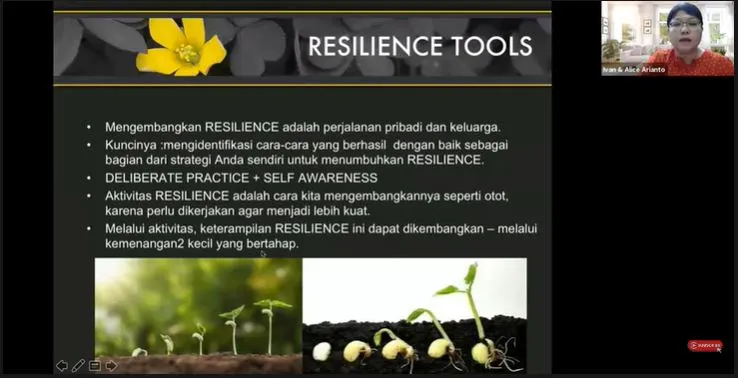 Bukan cuma otot fisik saja yang perlu dilatih, tapi otot mental kita juga. Otot spiritual, fisik, sosial, mental kita perlu dilatih terus. Salah satu caranya melatih mental kita dengan cara membaca firman Tuhan dan mengenali:
- Apa sumber daya kita? (Apa yang kita punya?)
- Apa kekuatan kita?
- Apa kemampuan kita?
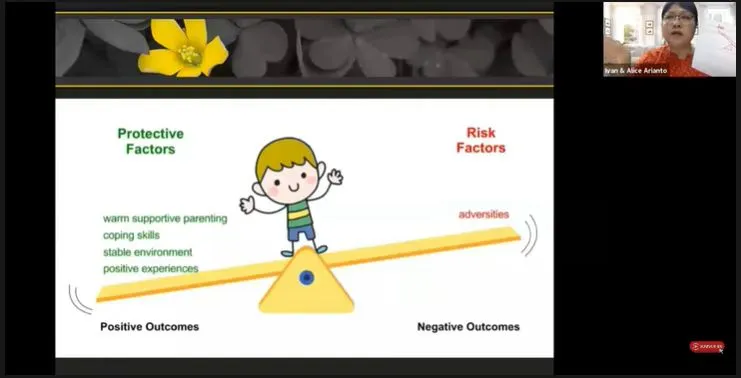
Seperti kesehatan mental, ketahanan juga memiliki timbangan. Saat kita bisa meningkatkan kesehatan mental, kita juga dapat memperkuat ketahanan mental kita. Ada 2 faktor yang mempengaruhi timbangan ketahanan mental ini, yaitu protective and risk factors. Protective factors adalah hal yang baik, sedangkan risk factors adalah hal yang buruk. Contoh protective factors adalah keluarga yang hangat, lingkungan yang stabil. Sedangkan risk factors adalah kebalikannya. Jika kita ingin meningkatkan resilience, kita perlu meningkatkan protective factors juga.
 Kita juga perlu untuk bangun hubungan yang baik, misalnya dengan komunikasi yang baik. Contohnya: puji anak ketika dia lakukan yang benar, dan berikan response yang baik terhadap orang yang berbicara kepada kita.
Semoga melalui acara ini, membuat kita semakin mengerti tentang pentingnya kesehatan mental, serta mau mau berjuang melatih diri memiliki ketahanan mental yang semakin kuat. Kita juga dapat membantu dan memperlakukan orang-orang disekitar kita yang mengalami masalah mental dengan lebih baik, menerima, mengasihi dan menghargai mereka. Memiliki mata dan hati yang seperti Yesus. Kita juga bisa mulai mempraktekan dalam keseharian kita setiap tips yang sudah dibagikan. Semangat!!
About the Author

Digital Ministry Team
The Digital Ministry Team is the digital ministry of GKDI (Gereja Kristus di Indonesia), bringing the good news of the gospel into digital spaces — through articles, videos, and content anyone can reach, anytime.
We write about faith, family, work, and everyday struggles — the real things people wrestle with, seen through an honest and down-to-earth biblical lens. Our hope is simple: that every article helps you know Jesus more closely and grow together with a community.
Have a question, some feedback, or a story to share? Reach us through GKDI social media or at [email protected].
God's House, Our Home.
RELATED ARTICLES

New Life, New Beginning
Everything new is usually appealing, including a new life. That is, when we leave the old behind and step into an experience that is truly new. Speaking of a new life, there is…
Read More
Christmas Day, Time to Reflect on These 3 Things
When I was little, Christmas Day was a special day. Besides receiving many gifts from Sunday school, I was also treated to many attractions such as dramas, Christmas songs...
Read More
3 Heart Attitudes from the Song Everlasting Father
For You are my Father, the everlasting Father. I am sure many of us are familiar with this song, Everlasting Father. Its lyrics lead us to reflect more deeply on God the Father and what He does in this life...
Read More